How to Get WiFi in the UK: A 2026 Traveler's Guide (No SIM Needed)
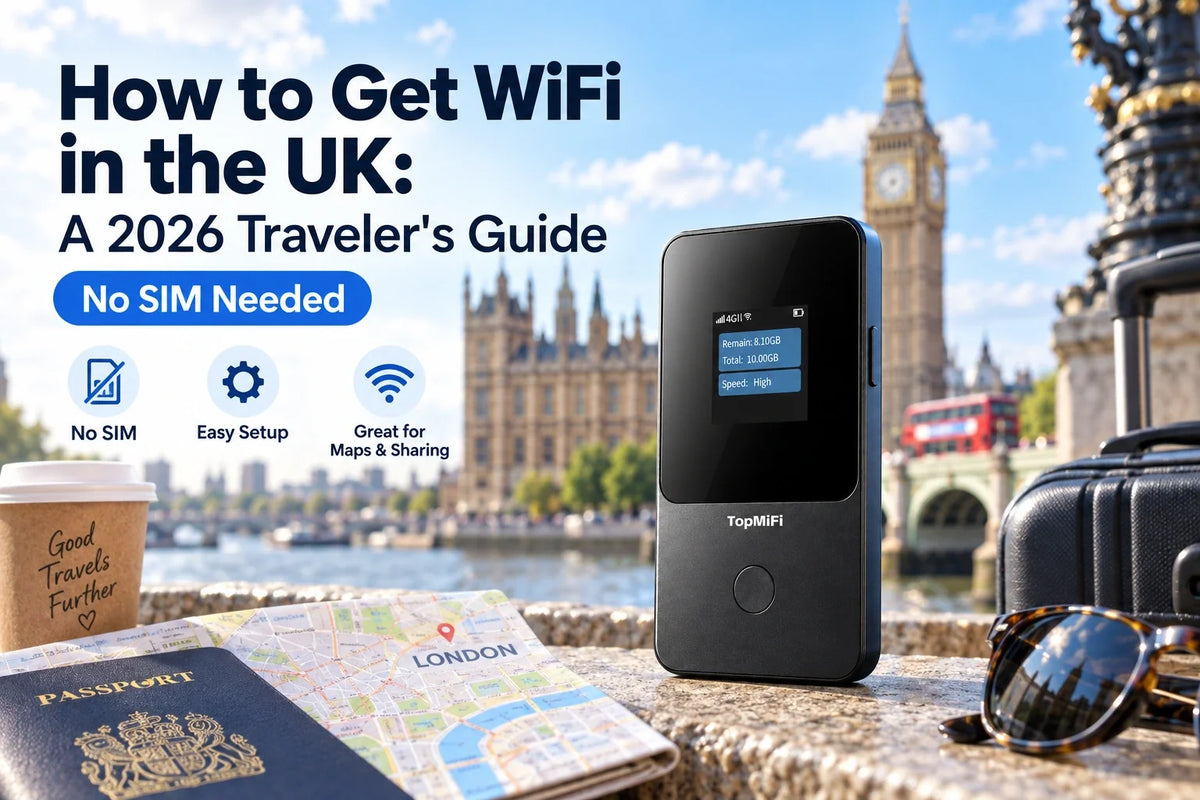
Sorting out how to get WiFi in the UK before you travel is one of the easiest ways to make the whole trip smoother — from finding your way through the London Underground to pulling up a map in a Highland village with no road signs in sight. You no longer need to queue for a local SIM at the airport: a no-SIM device like the TopMiFi T8 pocket WiFi connects to the UK's networks automatically the moment you land, with nothing to insert.
The right setup depends on how you travel — a solo city break in London, a couple touring the Cotswolds, or a family driving through Scotland and the Lake District each point to a different choice. That runs from a travel eSIM on your phone to an always-on unit like the TopMiFi TD20 as a shared base for a flat or holiday cottage.
The UK is also often paired with the rest of Europe, and since Brexit its roaming rules are their own special case — so if your route continues onto the continent, our wider guide to getting WiFi in Europe explains how one device keeps you online across every border.
And if you're hopping across the Channel, our guide to getting WiFi in France covers the same ground for Paris and beyond. Below we break down connectivity in the UK option by option, with the local detail that actually matters on the ground.
The short answer: You do not need a physical SIM card to get online in the UK. A travel eSIM or a no-SIM pocket WiFi device connects to the UK's strong local networks automatically, so you're online the moment you arrive — no shop, no card, no roaming bill.
Solo travelers with a compatible phone can lean on an eSIM; couples, families, and anyone with a laptop are better off with a portable hotspot that shares one connection across every device — and, because the UK sits outside the EU, it sidesteps the post-Brexit roaming muddle entirely.
Do you really need WiFi in the UK?
For most visitors, being connected turns a good UK trip into an effortless one. In London, Google Maps is how you decode the Tube, the Overground, and the bus network, find the right entrance to a sprawling site like the British Museum, and time a day trip around your train from a mainline station. Citymapper and live transit apps tell you which platform and which line in real time, and a live connection lets you book a timed slot for the Tower of London, reserve a restaurant table, or check the next train from a rural request stop on the spot.
Outside the cities, a connection matters just as much. Driving through the Cotswolds, the Scottish Highlands, Snowdonia, or the Lake District, up-to-date maps guide you down single-track lanes and help you find car parks and the right motorway services where signs are sparse. The UK drives on the left, which takes concentration if you're not used to it, so reliable turn-by-turn navigation is one less thing to worry about. Whether you're catching the last train back from a day out or working out bus times in a village with no timetable posted, a steady connection keeps the trip relaxed rather than stressful.
Is there free WiFi in the UK?
There is quite a lot, but not enough to build a trip around. The UK has some of the most widespread free public WiFi in Europe — most cafés, pubs, and hotels offer it, major chains and supermarkets have open networks, many city centres run free hotspots, and the Tube has WiFi at station platforms (though not yet reliably in the tunnels between them). In a pinch you can check messages over a café connection while you enjoy a coffee or a pint.
The limitations are the usual ones, though. Free WiFi in the UK is often slow, time-limited, and gated behind a login or an email sign-up, and hotel connections can crawl once the whole floor is online in the evening. Above all, it's stationary — no help while you're walking to dinner, riding a bus, or standing on a village street working out which way your cottage is. Treat free WiFi as a genuinely handy bonus, more plentiful than in many countries, but still a supplement rather than the backbone of your connectivity.
The Brexit twist: what post-Brexit roaming means for you
The UK is the one European destination where roaming deserves a special note, because Brexit changed the rules. The EU's "Roam Like At Home" scheme — which lets people with an EU mobile plan use their home allowance across the EU at no extra charge — no longer covers the UK. That cuts two ways depending on where you're coming from.
If you're an EU visitor, you can no longer assume your home plan works for free in Britain the way it would in Spain or Italy; several EU carriers have reintroduced roaming fees for the UK, so it's worth checking your plan before you rely on it. If you're coming from outside Europe — the US, Canada, Australia and elsewhere — your home carrier charges its standard international roaming rates here, which are usually the most expensive way to get online anywhere. Either way, the tidy solution is the same: a travel eSIM or a no-SIM hotspot sidesteps the whole roaming question, because it connects to a UK network directly rather than relying on your home plan's roaming terms. You simply land, connect, and never think about whose roaming rules apply.
Ways to get online in the UK, compared
There are five realistic ways to stay connected during a UK trip. Here's how each works and who it suits best.
1. Carrier roaming
Leaving your home SIM in and switching on international roaming is the zero-effort route — you land already connected. As covered above, post-Brexit this is a mixed bag: pricey for non-European visitors, and no longer automatically free for EU ones. It's fine for a single overnight, but rarely the smart choice for a full holiday.
2. A local UK SIM card
You can buy a prepaid SIM from a UK carrier at the airport or a high-street phone shop and swap it into your handset. The UK's networks are excellent and in-country data is affordable, but you'll queue, physically change your SIM and safeguard the original, and give up your normal number. It also only helps the one phone it's in — and a fresh UK SIM makes less sense if Britain is one leg of a wider European trip, since it won't help you once you cross to the continent.
3. A travel eSIM for the UK or Europe
If your phone supports it, you can install a UK or Europe data plan digitally before you leave home and switch it on when you arrive — no physical card at all. One thing to check: because the UK is outside the EU, confirm that a "Europe" eSIM explicitly includes the UK, as some regional plans don't. It's clean and quick for a solo traveler, though it covers only that one phone, and tethering to other devices drains your battery. If you're weighing a digital SIM against a shared device, our full comparison of eSIM vs pocket WiFi lays out the trade-offs.
4. Renting a pocket WiFi
You can rent a portable hotspot for your trip, picking it up at the airport or having it sent to your first hotel, and returning it when you leave. It shares one connection across your devices, but you'll pay a daily fee for every day of the trip, leave a deposit, and deal with pickup, return, and possible late or damage charges. It's convenient for a single one-off visit, but you're paying to borrow the same thing each time you travel.
5. Bringing your own no-SIM hotspot
A portable hotspot you own, with a built-in virtual SIM, connects to the UK's local networks automatically the moment you power it on — no card, no rental counter, no return deadline. It shares a private connection across all your devices and, because it works across 150+ countries, the same unit covers the rest of your European itinerary and every future trip. For anyone who travels more than once, owning beats renting on both cost and convenience.
Why "no-SIM" is the easiest way to get WiFi in the UK
Two of those five options — a travel eSIM and a no-SIM hotspot — skip the physical card entirely, and for most visitors that's exactly what you want in the UK. You avoid the airport SIM queue after a long flight, you keep your home number active, there's no tiny card to lose, and — uniquely for the UK — you step around the post-Brexit roaming question altogether. A good no-SIM setup has you online within a minute of landing, connected to the same reliable British networks a local SIM would use.
Coverage is the reason it works so well. The UK has strong 4G LTE across its cities, along the main rail routes, and through most of the countryside, so a device that hops onto a local carrier gives you fast, consistent data from central London to a Cornish beach. Signal can thin out in the Scottish Highlands, parts of rural Wales, and the remoter stretches of the Lake District and the Peak District — a good reason to save offline maps — but for the vast majority of a UK trip you'll barely think about your connection.
One device for the UK and the rest of Europe
Plenty of travelers pair the UK with the continent — London and Paris on one trip, or Britain as the start of a longer European loop — and this is where a no-SIM hotspot really earns its place. Because it connects automatically across 150+ countries, one device carries you from the UK onto the Eurostar and into France, then Belgium, the Netherlands, and beyond without buying a new plan or swapping anything at each border. You board the train at St Pancras and simply stay online the whole way.
That's a real advantage over a local UK SIM, which stops being useful the moment you leave the country, and over the roaming uncertainty that now sits between Britain and the EU. A single reusable device that spans both the UK and the continent is both simpler and cheaper than juggling a British SIM plus separate European coverage — and it means the Channel is just water, not a connectivity border.
How much data do you need for a trip to the UK?
The UK is a light-data destination for most travelers: your heaviest daily use is maps, browsing, messaging, and the occasional photo upload, all modest next to streaming video. These rough estimates help you plan a plan size:
| Activity in the UK | Rough data use | Intensity |
|---|---|---|
| Tube & maps | ~5 MB per hour | Very light |
| Browsing & bookings | ~10–25 MB per hour | Light |
| Messaging & social posts | ~10–30 MB per hour | Light |
| Video calls home | ~0.5–1.5 GB per hour | Heavy |
| Streaming on the train | ~1–3 GB per hour | Heavy |
A typical sightseeing day of maps, browsing, and messaging uses surprisingly little, so a plan that starts with data included and lets you top up as needed is ideal. If you'll stream or video-call home often, plan for the heavier end — and remember a shared hotspot pooling data across a family is far more efficient than everyone buying a separate plan.
What about calls and texts in the UK?
Most travel setups — eSIMs and pocket WiFi alike — are data-only, and in the UK that's rarely a problem. WhatsApp is the default way most people here message and call, and it's how many hosts, guides, and even some restaurants and taxi firms prefer to be reached. With a data connection active, WhatsApp, FaceTime, and other call and messaging apps work exactly as they do at home, with no traditional voice plan and no per-minute charges.
Your home number doesn't disappear either. Because a travel eSIM or a virtual-SIM hotspot adds data alongside your existing SIM rather than replacing it, your regular line stays in your phone — so you can still receive an important text, like a bank verification code, while doing your real communicating over apps. If you specifically need a UK number for a particular booking, that's one of the few cases a local SIM helps; for the vast majority of travelers, data plus WhatsApp covers the whole trip.
Setting up WiFi for your UK trip, step by step
Whichever no-SIM route you choose, getting connected in the UK is simple:
- Count your devices. Just your phone points to an eSIM; a partner, kids, or a laptop points to a portable hotspot.
- Arrange data before you fly. Install a UK or Europe eSIM plan (checking it covers the UK), or pack a hotspot that arrives with data included, so nothing needs sorting after you land.
- Switch on at the airport. Enable your eSIM line or power up the hotspot as you clear the terminal and give it a minute to find a UK network.
- Connect and navigate. Open your maps and transit apps and you're ready for the train or Tube into the city — no shop stop required.
- Top up if you need more. Add data as you go rather than over-buying up front.
Tips for staying connected across the UK
- Save offline maps of each area. Download London, plus your countryside and coastal regions in Google Maps so you can still navigate on a spotty Highland or rural stretch.
- Keep a hotspot charged for long days. A battery model doubles as a power bank; top it up overnight so it lasts a full day of sightseeing and train hops.
- Expect gaps in Tube tunnels and on rural rail. The Underground has WiFi on platforms but not reliably between stations, and remote train lines pass through dead spots — your device reconnects as soon as you're clear.
- Lean on it while driving on the left. Live maps handle the roundabouts, motorway junctions, and single-track lanes that road signs alone won't, so you can focus on the unfamiliar side of the road.
- Position a hotspot near a window. In a thick-walled old cottage or a period building, signal is stronger by a window, so place an always-on unit there as your room base.
WiFi in the UK: options at a glance
Here's how the main ways to get online in the UK compare on the questions travelers ask most.
| Option | Needs a physical SIM? | Best for |
|---|---|---|
| Your own no-SIM hotspot | No | Families, groups, multi-country Europe trips |
| Travel eSIM | No | Solo travelers with a compatible phone |
| Rental pocket WiFi | No | A one-off trip, no purchase wanted |
| Local UK SIM | Yes | Solo, longer single-country stays |
| Carrier roaming | Uses your home SIM | A quick overnight, zero setup |
Which option is right for your UK trip?
It comes down to who's traveling and how many devices need to be online. A solo visitor with a newer phone and light needs can do everything on a UK or Europe eSIM — quick to activate, nothing extra to carry. A couple sharing maps and photos, a family where the kids each have a device, or anyone bringing a laptop for work will get more from a portable hotspot that puts everyone on one private connection, without checking whether each phone supports an eSIM.
If the UK is one stop on a wider European tour — or the first of many future trips — owning a no-SIM device that spans 150+ countries makes the most sense, since it replaces a string of rentals, local SIMs, and roaming guesswork with a single reusable tool that works the same on both sides of the Channel. For a quick one-and-done visit where you'd rather not buy anything, an airport rental or a UK eSIM still does the job. Match the tool to the trip and you'll be online from the Tube platform to the Highland glen without a second thought.
Frequently asked questions
Do I need a SIM card to get WiFi in the UK?
No. You can stay online in the UK with a travel eSIM installed on your phone or a no-SIM pocket WiFi device with a virtual SIM — neither needs a physical card. A local UK SIM is one option among several, not a requirement.
Does the EU's free roaming still cover the UK after Brexit?
No. Since Brexit, the EU's "Roam Like At Home" scheme no longer includes the UK, and several EU carriers have brought back roaming fees for Britain. A travel eSIM or a no-SIM hotspot avoids the issue entirely, because it connects to a UK network directly rather than relying on your home plan's roaming terms.
Does a "Europe" eSIM or hotspot include the UK?
It depends on the plan, so always check. Because the UK is outside the EU, some regional Europe eSIMs exclude it. A good no-SIM hotspot with 150+ country coverage includes the UK alongside the continent, but it's worth confirming the UK is on the coverage list before you rely on it.
Is there enough free WiFi in the UK to skip getting data?
The UK has unusually widespread free WiFi in cafés, pubs, hotels, and city centres, but it's still slow, stationary, and often needs a login. It's a genuinely useful bonus, but not a dependable plan — you'll want your own connection for maps while you're actually moving around.
Will one device keep me online across the UK and the rest of Europe?
Yes, with a no-SIM hotspot. Because it connects automatically across 150+ countries, a single device carries you from the UK onto the Eurostar and into France, Belgium, and beyond with no new plan and nothing to swap — and no roaming border between Britain and the EU.
Does pocket WiFi work in the Scottish Highlands and rural Wales?
Across most of the UK, yes — cities, towns, and main routes have strong 4G LTE. In the remoter Highlands, parts of rural Wales, and the deeper countryside, signal can thin out, so save offline maps for those areas; the connection returns as soon as you're back within coverage.
Can one hotspot keep my whole family online in the UK?
Yes. A portable hotspot shares one private network across multiple phones, tablets, and laptops at once, so a family pools a single plan instead of buying separate data for each person — cheaper and simpler than everyone going it alone.
Does WiFi work on the London Underground?
Partly. Many Tube stations have WiFi on the platforms, and newer lines have coverage in some tunnels, but it isn't yet continuous across the whole network between stations. Download your route offline before you head down, and your hotspot or eSIM reconnects as soon as you're back above ground or on a covered stretch.
Should I rent a pocket WiFi in the UK or bring my own?
Renting suits a single one-off visit; owning a no-SIM device wins if you travel more than once, since it skips daily fees and returns and works across 150+ countries. Over a couple of trips, buying usually costs less and hassles you less.
Which messaging app should I use to stay in touch in the UK?
WhatsApp is the default in the UK and the easiest way to reach hosts, guides, and locals, but FaceTime, Messenger, and other apps all work fine over your data connection too. As long as you have a hotspot or eSIM active, any of them lets you call and message home for free.
The bottom line
Getting WiFi in the UK is easier than ever, and you don't need a SIM card to do it. Between a travel eSIM and a no-SIM pocket WiFi device, you can land and be online in about a minute — ready to navigate the Tube, catch your trains, book your bookings, and share the trip — with no shop queue and, importantly for Britain, none of the post-Brexit roaming guesswork. Solo travelers with a compatible phone can keep it light with an eSIM, while couples, families, and anyone continuing on to the continent are best served by a portable hotspot that shares one connection everywhere and spans 150+ countries on both sides of the Channel. Sort your data before you fly, and the UK — and the rest of Europe — opens up from the moment you arrive.
Stay connected in the UK with TopMiFi →
Coverage, device compatibility, data allowances, and roaming rules vary by option and destination and can change over time. Confirm current details, including whether a plan covers the UK, before you travel to make sure your chosen setup fits your trip.