Pocket WiFi vs eSIM vs Roaming vs Local SIM: Which Is Best Abroad? (2026)
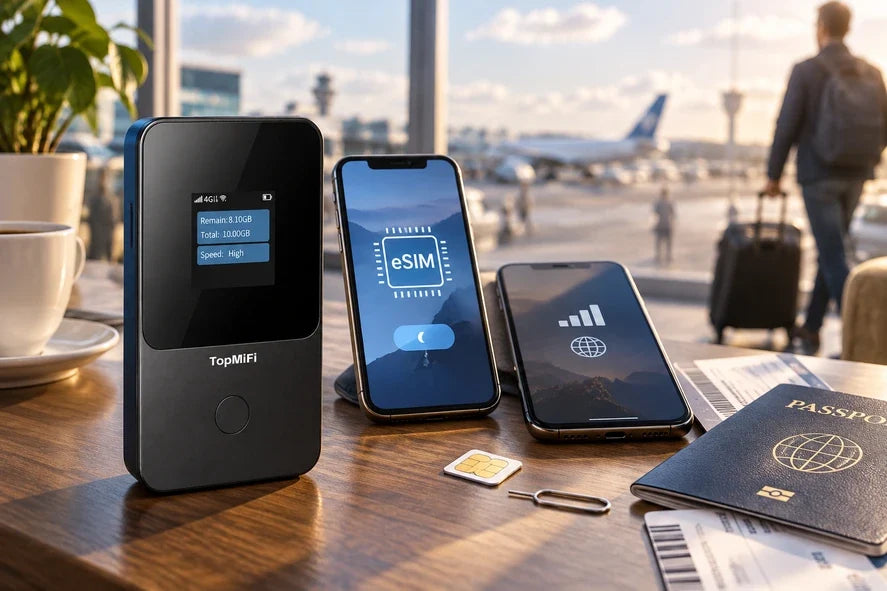
If you have ever landed in a new country, switched on your phone, and watched a "No Service" message replace your signal, you already know the problem this guide solves. Before your next trip you have four realistic ways to get online abroad: a pocket WiFi hotspot such as the TopMiFi T8 portable WiFi hotspot, an eSIM, international roaming from your home carrier, or a local SIM card bought at your destination. Each one can keep you connected — but they are very different in cost, setup, and how many devices they cover.
This guide compares all four so you can pick the right option for how you actually travel. We will keep it practical: what each one is, where it shines, where it frustrates, and which type of traveler it suits. Every option depends on local cellular coverage, so it also helps to check where your device will have coverage in 150+ countries before you commit.
Short answer
For most travelers who want one simple connection they can share across 150+ countries with no SIM swapping, a pocket WiFi hotspot is the easiest choice. Pick an eSIM if you only need data on one recent phone. Use roaming only for very short trips. Buy a local SIM if you are staying a long time in one country and don't mind a shop visit.
The four ways to get online abroad
1. Pocket WiFi hotspot
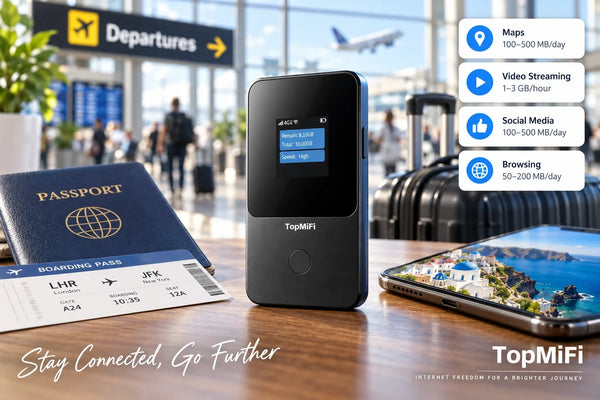
A pocket WiFi hotspot is a small 4G LTE device that creates your own private WiFi network wherever you have signal. You connect your phone, laptop, and tablet to it just like home WiFi. A device like the TopMiFi T8 works in 150+ countries with no SIM and no contract — it starts with 10GB, then you simply pay as you go.
Pros: one connection shared by up to 8 devices (T8); nothing to swap in your phone, so you keep your regular number and apps; works across many countries on a single device; easy to share with a travel companion or the whole family.
Cons: it is one more small device to carry and charge; like every option here it still needs local cellular coverage; there is a one-time device cost.
Best for: families, couples, multi-country itineraries, anyone traveling with several devices, and travelers who just want plug-and-play.
2. eSIM
An eSIM is a digital SIM you download onto a compatible phone, then buy a data plan for the country or region you are visiting. There is no physical card to insert.
Pros: nothing extra to carry; quick to install on a supported phone; a good fit when you only need data on one device.
Cons: only newer phones support it; it generally covers one device, so sharing with others is awkward; on a multi-country trip you often juggle or reinstall separate plans; handling your calls and texts alongside the eSIM can get fiddly.
Best for: solo travelers with one recent phone taking a single-country or single-region trip.
3. International roaming
Roaming simply uses your home carrier's plan abroad, usually for a daily fee or an add-on pass.
Pros: zero setup — it often switches on automatically; you keep your own number.
Cons: daily fees add up quickly on longer trips; plans can be slow or capped once you pass a data limit; it is the classic source of the "surprise bill" when you get home.
Best for: very short trips, or when your carrier already includes affordable roaming for the exact country you are visiting.
4. Local SIM card
A local SIM is one you buy after you arrive, from a shop or airport kiosk in the destination country.
Pros: often the lowest cost per GB while you are in that country; you get a local number.
Cons: you have to find a shop, sometimes show ID, and swap out your home SIM; it only covers one country and one device; a language barrier can make setup stressful on day one.
Best for: long stays in a single country, budget-first travelers who don't need their home number.
Pocket WiFi vs eSIM vs roaming vs local SIM: side by side
| Factor | Pocket WiFi | eSIM | Roaming | Local SIM |
|---|---|---|---|---|
| SIM needed | No SIM | Digital SIM | Your home SIM | New physical SIM |
| Works across many countries | Yes — 150+ on one device | Often per-country plans | Varies by carrier | One country only |
| Share with several devices | Yes — up to 8 (T8) | Usually one device | One phone (or hotspot it) | One phone |
| Keep your home number | Yes | Usually | Yes | No |
| Setup effort | Power on and connect | Install plan on phone | Often automatic | Shop visit on arrival |
| Cost model | Device once, then 10GB to start and pay as you go | Per-plan, per trip | Daily fee, adds up | Low per-GB in country |
| Best for | Families, multi-country trips, several devices | Solo, one recent phone | Very short trips | Long stay, one country |
Which should you choose?
Match the option to your trip rather than to the headline price:
- Visiting several countries on one trip? A pocket WiFi hotspot keeps the same connection across all of them, so you are not buying a new plan at every border.
- Traveling with family or a partner? One hotspot covers everyone's phones and tablets, instead of each person paying for their own plan.
- Solo, with one newer phone, one country? An eSIM is light and quick.
- Away for only two or three days? Roaming may be fine — check your carrier's daily fee first.
- Settling in one country for weeks or months? A local SIM usually wins on pure per-GB cost.
Where a pocket WiFi hotspot makes the most sense
Pocket WiFi is the easiest answer when you have more than one device, when you are traveling with other people, when your trip crosses several countries, or when you simply don't want to touch the SIM in your phone. The TopMiFi T8 is a handheld hotspot for up to 8 devices, and the TD20 is built for the car and supports up to 16. Both run on 4G LTE across 150+ countries with no SIM and no contract, starting with 10GB and then pay as you go.
Frequently asked questions
Is pocket WiFi better than an eSIM?
It depends on how you travel. A pocket WiFi hotspot is better when you want to share one connection across several devices or move between countries on a single trip. An eSIM can be simpler if you only need data on one recent phone in one place.
Do I still need a SIM card with a pocket WiFi hotspot?
No. A TopMiFi hotspot needs no SIM and no contract. You power it on, connect your devices to its WiFi, and you are online in 150+ countries.
How many devices can I connect at once?
The TopMiFi T8 supports up to 8 devices and the TD20 supports up to 16. That is enough for a family's phones, tablets, and a laptop on the same connection.
Will one device work in multiple countries on the same trip?
Yes. A TopMiFi hotspot works across 150+ countries, so you keep the same connection as you cross borders instead of buying a new plan in each country.
Is international roaming ever the best choice?
For very short trips it can be, especially if your carrier includes low-cost roaming for that exact country. On longer trips the daily fees usually make it the most expensive option.
The bottom line
There is no single winner for everyone — but there is a clear winner for each kind of trip. If you want the least hassle across multiple devices and multiple countries, a pocket WiFi hotspot is the simplest way to stay connected. See the TopMiFi T8 to start with 10GB in 150+ countries, no SIM and no contract, then pay as you go.