How to Get WiFi in Europe: A 2026 Traveler's Guide (No SIM Needed)
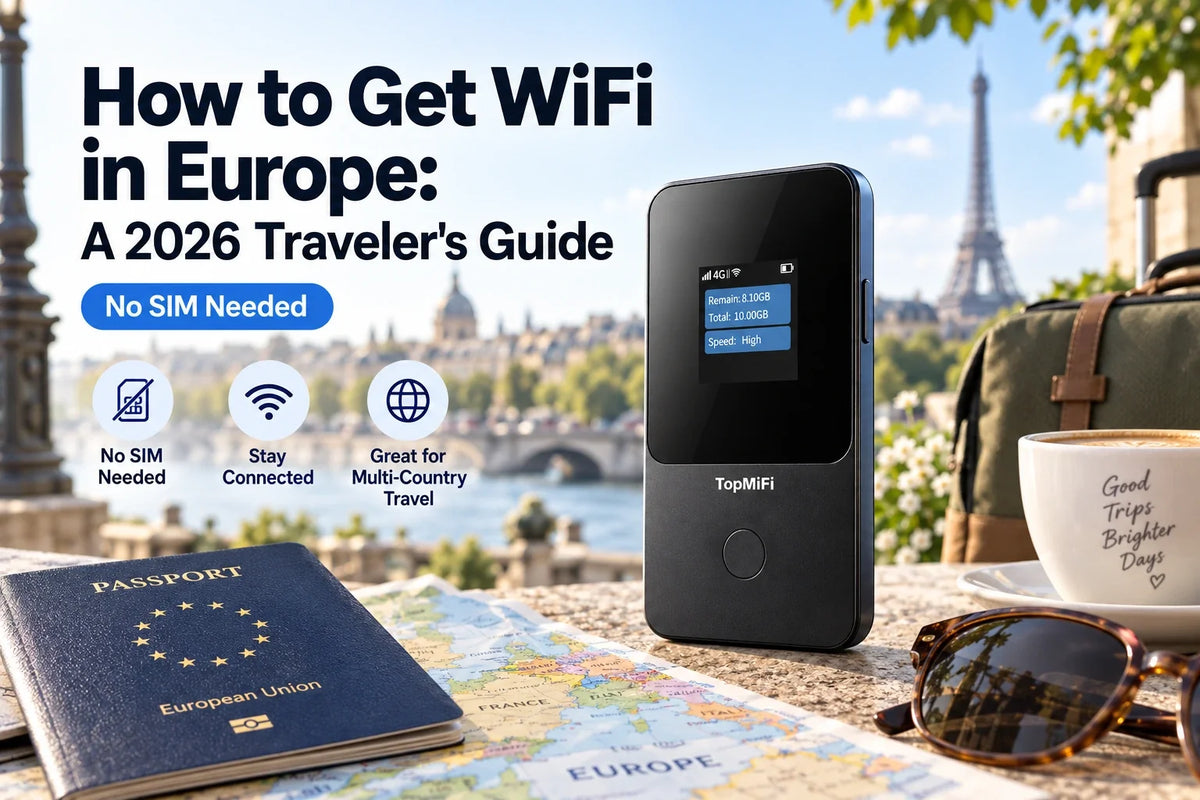
Working out how to get WiFi in Europe is the one piece of trip prep that quietly shapes everything else — because a European holiday usually means several countries, several languages, and a lot of trains, and you'll want to be online for all of it. The good news is you no longer need a SIM from each country: a no-SIM device like the TopMiFi T8 pocket WiFi connects automatically the moment you land and keeps working as you cross borders, with nothing to insert.
The right setup depends on how you travel — a solo city break, a couple on a rail tour, or a family renting an apartment as a base each point to a different choice. That runs from a travel eSIM on your phone to an always-on unit like the TopMiFi TD20 that keeps a whole group online from one connection.
This is a Europe-wide overview, but each country has its own quirks worth knowing. If your itinerary includes Italy, our dedicated guide to getting WiFi in Italy covers the local detail, from the trains to the ZTL driving zones.
And if France is on the route, our guide to getting WiFi in France does the same for Paris and beyond. Below we break down connectivity across Europe option by option, with the details that actually matter for a multi-country trip.
The short answer: You do not need a physical SIM card to get online in Europe. A travel eSIM or a no-SIM pocket WiFi device connects automatically, so you're online the moment you arrive — and a good hotspot keeps working as you cross from one country to the next, with no new plan at each border.
For a single country you have lots of options; for a multi-country trip, one device that spans 150+ countries is the simplest and usually cheapest way to stay connected the whole way.
Do you really need WiFi in Europe?
For most visitors, being connected turns a complex multi-city trip into a smooth one. Google Maps is how you navigate unfamiliar metro systems, find the right platform for a cross-border train, and walk to your apartment down streets that were laid out centuries before road signs. Translation apps make menus, museum labels, and station announcements readable in a dozen different languages, and a live connection lets you book timed museum tickets, reserve restaurants, and check ferry or train times on the move.
It matters even more because Europe packs so much variety into a short distance. You might have breakfast in one country and dinner in another, switch currencies when you cross from the eurozone into the UK or Switzerland, and move between regions where almost no one speaks your language. A reliable connection is what ties all of that together, so you spend your trip exploring rather than standing on a corner hunting for a signal.
The real challenge in Europe: crossing borders
What makes connectivity in Europe different from a single-country trip is borders. The Schengen area lets you cross between many countries with no passport check, but your mobile connection doesn't automatically follow the same rules — each country has its own carrier networks, and a plan bought in one place may not work, or may cost extra, in the next. On a trip that takes in Paris, Amsterdam, Rome, and Barcelona, that's four potential changes to manage.
This is exactly where the different options separate. A local SIM covers one country and becomes dead weight the moment you leave it. Some eSIM plans are sold per country, so a four-country trip could mean four plans. The approaches that shine in Europe are the ones that treat the whole continent as one connection — which is why travelers increasingly skip the per-country juggling entirely.
Does the EU's "free roaming" apply to me?
This is the question that trips up a lot of visitors. The EU's "Roam Like At Home" rule lets people who live in the EU use their home mobile allowance in other EU and EEA countries at no extra charge. It's genuinely useful — but only if you have an EU or EEA mobile plan to begin with.
If you're travelling from outside Europe — from the US, Canada, Australia, or anywhere else — that benefit does not apply to you. Your home carrier will charge its own international roaming rates, which are usually the most expensive way to use data anywhere. So the free-roaming headlines you may have read are real, but they're a perk for European residents, not a plan a visitor can rely on. For everyone arriving from abroad, a travel eSIM or a no-SIM hotspot is the sensible route, and it sidesteps the whole roaming question.
Ways to get online in Europe, compared
There are five realistic ways to stay connected on a Europe trip. Here's how each works and who it suits best.
1. Carrier roaming
Leaving your home SIM in and switching on international roaming is the zero-effort route — you land already connected. For travelers from outside Europe it's almost always the most expensive option, and a multi-week trip across several countries adds up fast. It's fine for a single overnight, but rarely the right call for a real European holiday.
2. Local SIM cards
You can buy a prepaid SIM in each country you visit. Networks across Europe are good and in-country data is affordable, but you'll queue, sometimes show ID, swap and safeguard your home SIM, and lose your normal number — and you'd repeat all of that every time you cross a border. It only really makes sense if you're spending a long time in one country.
3. A travel eSIM for Europe
If your phone supports it, you can install a data plan digitally before you leave home. Look specifically for a regional "Europe" eSIM that covers many countries on one plan, rather than a single-country plan you'd have to replace at each border. It's clean and quick for a solo traveler, though it covers only that one phone, and tethering to other devices drains your battery.
4. Renting a pocket WiFi
You can rent a portable hotspot for your trip, collecting it at the airport or having it sent to your first hotel, and returning it at the end. It shares one connection across your devices and travels with you between countries, but you'll pay a daily fee for every day of the trip, leave a deposit, and handle pickup, return, and possible late or damage charges. It's convenient for a single one-off visit.
5. Bringing your own no-SIM hotspot
A portable hotspot you own, with a built-in virtual SIM, connects to local networks automatically the moment you power it on — no card, no rental counter, no return deadline. Crucially for Europe, it keeps working as you move from country to country, because it reaches across 150+ countries on one device. It shares a private connection across all your gadgets, and the same unit covers every future trip too.
Why "no-SIM" is the easiest way to get WiFi in Europe
Two of those five options — a regional eSIM and a no-SIM hotspot — skip the physical card entirely, and for a multi-country trip that's exactly what you want. You avoid the airport SIM queue after a long flight, you keep your home number active, and there's no card to swap every time you cross a border. A good no-SIM setup has you online within a minute of landing and stays connected all the way through your itinerary.
The deciding factor is how many countries and devices you're covering. A hotspot that reaches 150+ countries treats Europe as a single connection: you step off a train in a new country and simply stay online, with no plan to buy and nothing to reconfigure. For anyone moving between cities or nations — which describes most European trips — that seamless border-crossing is worth more than any single feature on the spec sheet.
WiFi for a multi-country Europe trip
Picture a classic two-week route: a few days in Paris, the train down to Barcelona, a flight to Rome, then on to Amsterdam before flying home. With local SIMs, that's up to four shop visits and four numbers. With per-country eSIMs, it could be four separate plans to buy and activate. With a single no-SIM hotspot, it's one device you switch on in Paris and never think about again — it reconnects automatically in Spain, Italy, and the Netherlands without you lifting a finger.
That's the core reason a reusable device wins for Europe specifically. The continent rewards travelers who hop around, and the more borders your trip crosses, the more a one-device, one-connection approach saves in both money and hassle. It also means everyone in your group — partners, kids, a work laptop — shares the same stable network the whole way, instead of each person sorting out their own coverage country by country.
How much data do you need for a Europe trip?
Europe is a light-data destination for most travelers: your heaviest daily use is maps, translation, browsing, messaging, and the occasional photo upload, all modest next to streaming video. These rough estimates help you plan a plan size:
| Activity in Europe | Rough data use | Intensity |
|---|---|---|
| Maps & metro navigation | ~5 MB per hour | Very light |
| Translation & browsing | ~10–25 MB per hour | Light |
| Messaging & social posts | ~10–30 MB per hour | Light |
| Video calls home | ~0.5–1.5 GB per hour | Heavy |
| Streaming on the train | ~1–3 GB per hour | Heavy |
A typical sightseeing day of maps, translation, and messaging uses surprisingly little, so a plan that starts with data included and lets you top up as needed is ideal. If you'll stream or video-call home often, plan for the heavier end — and remember a shared hotspot pooling data across a family is far more efficient than everyone buying a separate plan.
What about calls and texts in Europe?
Most travel setups — eSIMs and pocket WiFi alike — are data-only, and across Europe that's rarely a problem. WhatsApp is the default way to stay in touch almost everywhere on the continent, and it's how many hotels, hosts, and tour operators prefer to be reached. With a data connection active, WhatsApp, FaceTime, and other call and messaging apps work exactly as they do at home, with no traditional voice plan and no per-minute charges.
Your home number doesn't disappear either. Because a travel eSIM or a virtual-SIM hotspot adds data alongside your existing SIM rather than replacing it, your regular line stays in your phone — so you can still receive an important text, like a bank verification code, while doing your real communicating over apps. For the vast majority of travelers, data plus messaging apps covers the whole trip, in every country.
Setting up WiFi for your Europe trip, step by step
Whichever no-SIM route you choose, getting connected across Europe is simple:
- Count your devices and countries. One phone in one country can suit an eSIM; several devices or several countries point firmly to a portable hotspot.
- Arrange data before you fly. Install a regional Europe eSIM, or pack a hotspot that arrives with data included, so nothing needs sorting after you land.
- Switch on at the airport. Enable your eSIM line or power up the hotspot as you clear the terminal and give it a minute to find a local network.
- Connect and keep it on. Your devices join the hotspot once, and it reconnects automatically each time you cross into a new country — no need to reconfigure.
- Top up if you need more. Add data as you go rather than over-buying up front.
Tips for staying connected across Europe
- Save offline maps for every city. Download each destination in Google Maps so you can navigate even on a spotty rural or mountain stretch between countries.
- Keep a hotspot charged for long days. A battery model doubles as a power bank; top it up overnight so it lasts a full day of sightseeing and train hops.
- Expect brief drops in tunnels and the Alps. Cross-border trains and mountain routes pass through tunnels and high passes where any device may pause, then reconnect — normal, not a fault.
- Remember non-euro countries still need data. The UK, Switzerland, and others use different currencies, but a good hotspot covers them the same way — handy for currency conversion and maps on the spot.
- Position a hotspot near a window. In a thick-walled old apartment or hotel, signal is stronger by a window, so place an always-on unit there as your room base.
WiFi in Europe: options at a glance
Here's how the main ways to get online across Europe compare on the questions travelers ask most.
| Option | Crosses borders easily? | Best for |
|---|---|---|
| Your own no-SIM hotspot | Yes — 150+ countries, automatic | Multi-country trips, families, groups |
| Regional Europe eSIM | Yes, within its country list | Solo travelers with a compatible phone |
| Rental pocket WiFi | Usually — check the plan | A one-off trip, no purchase wanted |
| Local SIM cards | No — one per country | A long stay in a single country |
| Carrier roaming | Yes, at a high price | A quick overnight, zero setup |
Which option is right for your Europe trip?
It comes down to how many countries and devices you're covering. A solo visitor with a newer phone staying mostly in one or two countries can do well with a regional Europe eSIM — quick to activate, nothing extra to carry. A couple sharing maps and photos, a family where the kids each have a device, or anyone bringing a laptop for work will get more from a portable hotspot that puts everyone on one private connection, without checking whether each phone supports an eSIM.
If your trip crosses several borders — or it's the first of many future trips — owning a no-SIM device that spans 150+ countries makes the most sense, since it replaces a string of SIMs, rentals, and roaming bills with a single reusable tool that works the same from Lisbon to Vienna. For a quick single-city visit where you'd rather not buy anything, an airport rental or a regional eSIM still does the job. Match the tool to the shape of your trip and you'll stay online from the first platform to the last.
Frequently asked questions
Do I need a SIM card to get WiFi in Europe?
No. You can stay online across Europe with a regional travel eSIM on your phone or a no-SIM pocket WiFi device with a virtual SIM — neither needs a physical card, and both can span multiple countries on one setup.
Does one device work across all of Europe?
Yes, with a no-SIM hotspot. Because it connects automatically across 150+ countries, a single device carries you from France into Italy, Spain, Germany, and beyond with no new plan and nothing to swap at the border.
Can I use the EU's free roaming as a tourist from abroad?
No. "Roam Like At Home" is a benefit for people with an EU or EEA mobile plan using it within the EU. If you're travelling from the US or elsewhere outside Europe, your home carrier charges standard roaming rates, so a travel eSIM or no-SIM hotspot is the better route.
Does it also cover non-EU countries like the UK and Switzerland?
A good no-SIM hotspot does, because its 150+ country coverage isn't tied to the EU. The UK and Switzerland use different currencies and sit outside the EU, but the same device keeps you online there — just confirm a specific country is on the coverage list before you rely on it.
Can one hotspot keep my whole family online across Europe?
Yes. A portable hotspot shares one private network across multiple phones, tablets, and laptops at once, so a family pools a single plan instead of buying separate data for each person in each country — far cheaper and simpler than everyone going it alone.
Is a Europe eSIM or a pocket WiFi better?
A regional eSIM suits a solo traveler with a compatible phone and light needs; a pocket WiFi is better for couples, families, multiple devices, and trips that cross several borders, since one device covers everyone everywhere. Match it to how many people and countries you're covering.
Should I rent a pocket WiFi or bring my own for Europe?
Renting suits a single one-off visit; owning a no-SIM device wins if you travel more than once, since it skips daily fees and returns and works across 150+ countries. Over a couple of trips, buying usually costs less and hassles you less.
How far in advance should I sort my travel data?
Ideally before you fly. Installing a regional eSIM or packing a data-ready hotspot in advance means you arrive already prepared — you switch it on and connect, with no scramble at the airport. Same-day activation is possible with an eSIM, but arranging it early removes any last-minute stress.
Does pocket WiFi work on cross-border trains like the Eurostar?
On land, yes — a hotspot stays connected to local networks as a train travels, including across borders, so it keeps working from one country into the next. You may see brief pauses in long tunnels, such as under the Channel or through the Alps, but the signal returns on the other side.
Which messaging app should I use to stay in touch in Europe?
WhatsApp is the default across most of Europe and handy for reaching hotels, hosts, and locals, but FaceTime, Messenger, and other apps all work fine over your data connection too. As long as you have a hotspot or eSIM active, any of them lets you call and message home for free.
The bottom line
Getting WiFi in Europe is easier than ever, and you don't need a SIM card — or a different plan for every country — to do it. Between a regional travel eSIM and a no-SIM pocket WiFi device, you can land and be online in about a minute, then stay connected as you cross borders, with no shop queues and no roaming shock. Solo travelers staying put can keep it light with a Europe eSIM, while couples, families, and anyone touring several countries are best served by a portable hotspot that shares one connection everywhere and spans 150+ countries. Sort your data before you fly, and the whole continent opens up — one connection, from the first city to the last.
Stay connected across Europe with TopMiFi →
Coverage, device compatibility, and data allowances vary by option and destination and can change over time. Confirm which countries are covered before you travel to make sure your chosen setup fits your European route.