How to Get WiFi in the USA: A 2026 Traveler’s Guide (No SIM Needed)
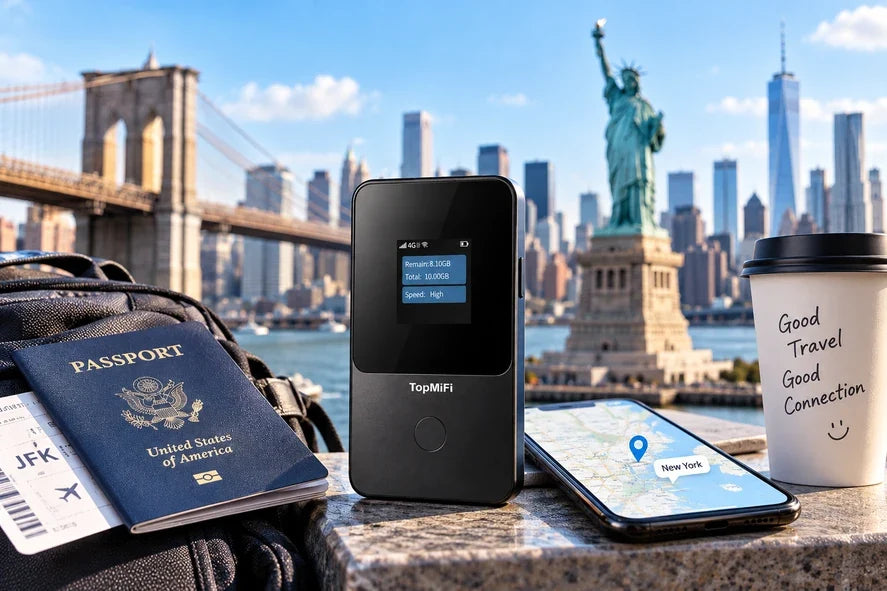
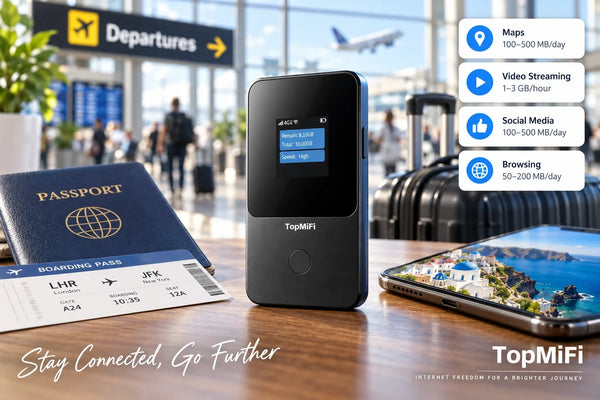
The United States is a country you experience by moving through it — city to city, coast to coast, down long interstates and out to national parks that are bigger than some countries. All of that movement runs on a live connection: for maps, for booking, for ride-hailing, and for staying in touch. If you are visiting from abroad, the simplest way to stay online for the whole trip is a pocket WiFi hotspot such as the TopMiFi T8 portable WiFi hotspot, which creates your own private WiFi network in 150+ countries — the USA included — with no SIM and no contract.
This 2026 guide covers every realistic way to get internet in the USA, what to know about coverage on road trips and in the big cities, how to set your device up, and how much data you actually need. Because the country is so vast, it is worth checking where your device will have coverage before you rely on it from downtown to the desert.
Quick answer
For most visitors to the USA, a pocket WiFi hotspot is the easiest way to stay online: one device keeps your phone, your travel companion's phone, and a laptop connected at once, with no SIM to swap and no contract. You power it on when you land, connect your devices, start with 10GB, and then pay as you go. A local prepaid SIM or an eSIM works for a single phone; roaming is easy but adds up; public WiFi is a backup, not a plan.
Why staying connected matters so much in the USA
The US rewards travellers who can navigate, book, and improvise on the move — and almost all of that depends on data in your pocket. Here is where you will lean on a connection.
- Navigation. Distances are enormous and much of the country is built around driving. A live map is essential whether you are threading through Los Angeles traffic or finding a trailhead in Utah.
- Road trips. The classic American trip is a drive — Route 66, the Pacific Coast Highway, a loop through the national parks. Real-time maps, fuel stops, and weather all need a connection.
- Ride-hailing and transit. In cities you will lean on ride-hailing apps and transit apps, both of which expect you to be online to book and pay.
- Bookings and entry times. Hotels, popular restaurants, and even timed entry to major attractions and some national parks increasingly run through apps you manage on the go.
- Staying in touch. Keeping up with family back home, sharing photos, and handling anything from work runs on a connection you can trust.
Put together, your phone is your map, your driver, and your booking desk across a very big country. A reliable connection is what keeps a US itinerary moving.
What to know about getting online in the USA
The US is straightforward to connect in compared with some destinations, but a few things are worth understanding before you arrive.
Local prepaid SIMs usually mean a store visit. You can buy a US prepaid SIM, but it often involves finding a store, sometimes showing ID, and swapping out your home SIM — friction on your first jet-lagged day. A pocket WiFi hotspot skips that entirely, because there is no SIM to buy and nothing to register.
Roaming can be expensive. Switching on your home carrier's roaming is the easiest option, but daily fees or per-megabyte charges add up quickly across a one- or two-week trip. Check your plan's US rate before you depend on it.
Public WiFi is common but patchy. Hotels, coffee shops, and airports usually offer WiFi, but it is stationary, varies in speed, and is not something to rely on while you are driving between places or exploring outdoors.
The country is huge, with real dead zones. Coverage in cities and along major highways is generally strong, but remote stretches — deserts, mountain passes, the interiors of large national parks — can drop signal on any network. That is normal, and the fix is preparation, which we cover below.
Your options for internet in the USA
There are five common ways to get online in the US. Each can work; they suit different travellers and trip styles.
| Option | Best for | Watch out for |
|---|---|---|
| Pocket WiFi hotspot | Groups, families, road trips, multi-device travellers | One device to carry and charge; coverage fades in very remote areas |
| Local prepaid SIM | Longer solo stays, one phone, budget per-GB cost | Store visit; swapping your home SIM; one device only |
| Travel eSIM | Solo travellers with one recent, compatible phone | One device; needs a supported phone |
| International roaming | Very short trips, if your carrier's US rate is reasonable | Daily fees add up; check before you go |
| Free public WiFi | Light backup in a hotel, cafe, or airport | Stationary and uneven; not for the road or outdoors |
The honest summary: public WiFi is a backup, not a plan; a prepaid SIM is cheap per GB if you are staying a while and do not mind the store trip; an eSIM suits a solo traveller with one modern phone; roaming is the easiest to switch on but the priciest over a longer trip. Pocket WiFi is the option that covers a whole group and comes with you from the city to the open road.
Why pocket WiFi is a strong fit for the USA
A pocket WiFi hotspot suits the way most people actually travel the United States, for a few concrete reasons.
First, the US is a road-trip country. So much of the classic American trip happens in a car, moving between cities, parks, and small towns, and you want a connection that travels with you the whole way rather than one tied to a single cafe. A hotspot in the car keeps maps, music, and messaging live for everyone on board.
Second, people rarely travel the US with a single device. A couple brings two phones and a tablet; a family adds devices for the kids on long drives; a solo traveller still often carries a phone and a laptop. The TopMiFi T8 supports up to 8 devices, so one connection covers the whole group instead of each person buying a separate plan.
Third, it travels beyond the US. Many trips pair the States with Canada, Mexico, or a longer journey. Because a TopMiFi device works across 150+ countries, the same hotspot keeps you online across the whole route. If the US is one leg of a bigger trip, our complete guide to pocket WiFi for international travel covers how one device handles every border.
Where it works across the USA
Coverage is the question that matters most on a US trip, so here is what to expect across the places you are most likely to go.
Major cities. In New York, Los Angeles, Chicago, San Francisco, Las Vegas, Miami, and the rest, coverage is dense and consistent. Expect a steady connection in the streets, on transit, and across the big airports.
Interstates and highways. The major road network is generally well covered, so you can navigate, check traffic, and find fuel and food along the way. Signal can dip through remote mountain passes and empty desert stretches, then returns as you approach towns.
National parks and remote areas. This is where to set expectations carefully. Iconic parks such as Yellowstone, Grand Canyon, Yosemite, and Zion are huge, and large parts of them have little or no mobile signal on any network. The same is true of deep desert, backcountry trails, and some rural regions. This is not specific to any one device — it is the nature of remote America — so plan for stretches offline.
The practical takeaway: for a trip centred on cities and highways, a pocket WiFi hotspot gives you a reliable connection almost everywhere you will be. For national parks and backcountry, treat offline maps as essential, and confirm coverage for your specific route before you depend on it.
How to prepare for a US road trip
- Download offline maps. Before you drive into a park or a remote region, save offline maps so navigation works without signal.
- Plan fuel and stops in advance. On long desert or mountain legs, know where your next fuel, food, and rest stops are, since you may be offline between them.
- Save key details offline. Keep reservation numbers, addresses, and park information saved so you are not stranded without them.
- Confirm coverage for your route. Whatever connection you choose, check it against the specific cities, highways, and parks on your itinerary.
- Keep your home number active. With a pocket WiFi hotspot you do not swap your SIM, so your usual number and two-factor codes keep working.
How to set up your pocket WiFi
- Power on when you land. Turn the device on after you clear the airport. Where there is coverage, it connects automatically — no SIM to insert, no store to find.
- Connect your devices. Join the hotspot's WiFi from your phone, tablet, or laptop, and share the password so everyone in your group is online.
- Start with 10GB, then pay as you go. Your device begins with 10GB; the screen shows what is left, so you top up only when you need more — no contract and no auto-renew after your trip.
How much data do you need in the USA?
It depends on how you travel. Maps, messaging, ride-hailing, and bookings are relatively light; streaming music and video on long drives and uploading lots of high-resolution photos are heavier, the same as anywhere. Because your TopMiFi starts with 10GB and then lets you pay as you go, you do not have to guess perfectly before you leave — watch the counter on the device and top up only if you actually run low.
Which TopMiFi suits a US trip?
For most visitors, the handheld T8 is the right choice: it is pocket-sized, carries its own rechargeable battery, supports up to 8 devices, and goes everywhere you go — walking Manhattan, riding a cable car, or hiking a canyon rim. If your trip is a serious road trip or you are renting an RV, the TD20 is built for the car and supports up to 16 devices, which suits a vehicle full of people and screens. Both run on 4G LTE across 150+ countries with no SIM and no contract.
Tips for staying connected in the USA
- Charge it overnight. If you are carrying the battery-powered T8, top it up each night so you start every day of sightseeing or driving with a full charge.
- Keep the hotspot with the navigator. On a road trip, the hotspot rides up front with whoever is navigating; devices connect within WiFi range.
- Download before the parks. Save maps and trail information before you lose signal in a national park, not after.
- Share the password once. Everyone on the trip joins the same connection, so there is nothing to sort out per person.
Frequently asked questions
Do I need a SIM card to get online in the USA?
No. A pocket WiFi hotspot needs no SIM and no contract. You power it on in the US, connect your phone and other devices to its WiFi, and you are online — no SIM to buy, swap, or register.
Will pocket WiFi work on a US road trip?
Yes, along cities and major highways you will generally have a steady connection. In remote deserts, mountain passes, and the interiors of large national parks, signal can fade on any network, so download offline maps as a backup and confirm coverage for your route.
How many devices can I connect?
The TopMiFi T8 supports up to 8 devices and the TD20 supports up to 16 — enough for a family's phones, tablets for the kids on a long drive, and a laptop, all on one connection.
Is pocket WiFi better than a US prepaid SIM?
It depends on your trip. A prepaid SIM can be cheaper per GB for a long solo stay, but it means a store visit and only covers one phone. Pocket WiFi covers a whole group with no SIM and no store trip, which suits families, couples, and road trips.
Will one device also work outside the USA on the same trip?
Yes. A TopMiFi hotspot works across 150+ countries, so the device that keeps you online in the US also works if your trip continues to Canada, Mexico, or beyond — with no new plan at each border.
How much data should I get for the USA?
It depends on your habits — maps and messaging are light, while streaming on long drives is heavy. Your device starts with 10GB, and because you pay as you go, you can simply top up if you run low rather than overbuying in advance.
The bottom line
The USA is a country you cover a lot of ground in, and staying connected is what keeps the trip moving — through the cities, down the highways, and up to the edges of the national parks. For most visitors, a pocket WiFi hotspot is the simplest way to keep the whole group online from the moment you land, with no SIM, no contract, and no surprise bill waiting at home. Start with the TopMiFi T8 for 10GB in 150+ countries, then pay as you go.