How to Get WiFi in Germany: A 2026 Traveler's Guide (No SIM Needed)
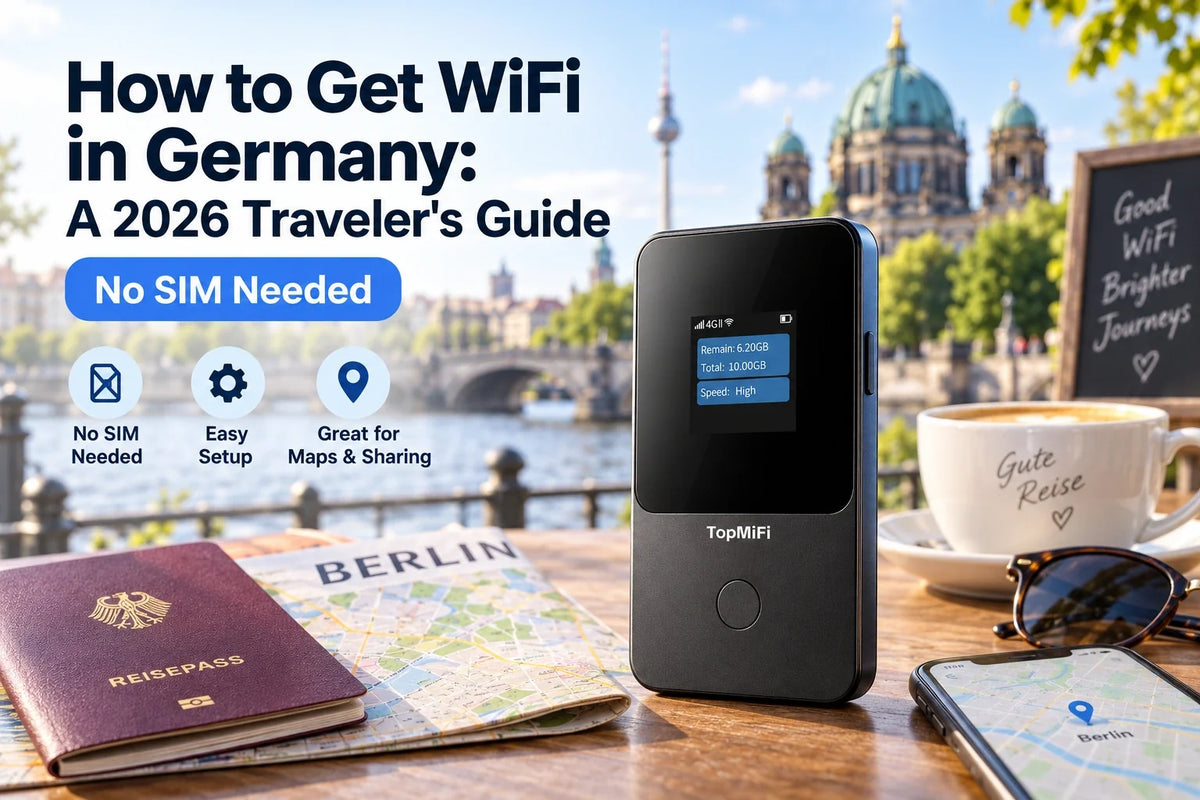
Working out how to get WiFi in Germany before you go is one of the simplest ways to make the trip run smoothly — from decoding the Berlin U-Bahn to finding a village guesthouse in the Black Forest where the road signs run out. You don't need to hunt down a local SIM at the airport: a no-SIM device like the TopMiFi T8 pocket WiFi connects to Germany's networks automatically the moment you land, with nothing to insert.
The right setup depends on how you travel — a solo city break in Berlin, a couple at Oktoberfest in Munich, or a family driving the Romantic Road each point to a different choice. That runs from a travel eSIM on your phone to an always-on unit like the TopMiFi TD20 as a shared base for an apartment or holiday flat.
Germany also sits right at the heart of Europe, so it's rarely a trip on its own — and that makes one connection across borders especially handy. If your route runs on to neighbouring countries, our wider guide to getting WiFi in Europe explains how a single device keeps you online across every frontier.
And if you're pairing Germany with a hop west, our guide to getting WiFi in France covers the same ground for Paris and beyond. Below we break down connectivity in Germany option by option, with the local detail that actually matters on the ground.
The short answer: You do not need a physical SIM card to get online in Germany. A travel eSIM or a no-SIM pocket WiFi device connects to Germany's local networks automatically, so you're online the moment you arrive — no shop, no card, no roaming surprises.
Solo travelers with a compatible phone can lean on an eSIM; couples, families, and anyone with a laptop are better off with a portable hotspot that shares one connection across every device — and, because Germany sits inside the EU, it slots neatly into a wider European trip with no border to think about.
Do you really need WiFi in Germany?
For most visitors, being connected turns a good German trip into an effortless one. In Berlin, Munich, Hamburg, or Cologne, Google Maps and the local transit apps are how you decode the U-Bahn, S-Bahn, trams, and buses, find the right platform, and time a day around your train. Germany's railways run on the DB Navigator app, where you check live departures, platform changes, and delays in real time — and a live connection lets you buy a ticket on your phone, reserve a table, or book a timed museum slot on the spot.
Outside the cities, a connection matters just as much. Driving the Romantic Road, through Bavaria, the Black Forest, or along the Rhine, up-to-date maps guide you between villages and castles where signs are sparse. Germany is also still a surprisingly cash-friendly country — plenty of smaller cafés, bakeries, and guesthouses prefer cash — so being able to pull up the nearest ATM on a map is genuinely useful. Whether you're navigating the Autobahn or working out bus times in a small town, a steady connection keeps the trip relaxed rather than stressful.
Is there free WiFi in Germany?
There's a fair amount, but not enough to rely on. Most hotels, cafés, and restaurants offer free WiFi, major chains and department stores have networks, and many city centres, airports, and long-distance DB trains provide hotspots. In a pinch you can check messages over a café connection while you enjoy a coffee and a slice of cake.
The limitations are the familiar ones, though. Free WiFi in Germany is often slow, time-limited, and gated behind a login, and onboard train WiFi can be patchy once the carriage fills up. Germany also tends to be more privacy-conscious than some countries, so some networks ask for more sign-up detail than you'd like. Above all, it's stationary — no help while you're walking between sights, riding a tram, or standing on a village street working out your route. Treat free WiFi as a handy bonus, not the backbone of your connectivity.
The one thing to know: Germany's coverage and dead spots
Germany is the one Western European destination where it's worth setting expectations on coverage, because its mobile network has a reputation that's only partly deserved. In the big cities and along major routes, 4G LTE and 5G are fast and reliable — Berlin, Munich, Frankfurt, and Hamburg are thoroughly covered. But Germany is also known for its "Funklöcher" — dead spots — in rural areas and, famously, on some stretches of railway, where your signal can drop out for a few minutes as the train passes through a gap in coverage.
The networks have been investing heavily to close these gaps, especially along train lines, and coverage keeps improving year on year — but if your trip includes long rail journeys or time in the countryside, the Black Forest, or the Alps, it's realistic to expect the occasional drop rather than flawless signal everywhere. The practical takeaway: a good no-SIM device connects to whichever local network is strongest in a given spot, which is the best way to stay on the air — and saving offline maps for rural stretches covers you for the rare dead spot. This is a coverage quirk to plan around, not a reason to worry.
Ways to get online in Germany, compared
There are five realistic ways to stay connected during a German trip. Here's how each works and who it suits best.
1. Carrier roaming
Leaving your home SIM in and switching on international roaming is the zero-effort route — you land already connected. Travelers from elsewhere in the EU benefit from "Roam Like At Home" and use their domestic allowance in Germany at no extra cost. For everyone else — visitors from the US, Canada, Australia, the UK, and beyond — your home carrier charges standard international roaming rates, which are usually the most expensive way to get online. Fine for a single overnight; rarely the smart choice for a full trip.
2. A local German SIM card
You can buy a prepaid SIM from a German carrier at the airport, a phone shop, or even some supermarkets and drugstores, and swap it into your handset. In-country data is affordable and the networks are good, but you'll queue, physically change your SIM and safeguard the original, and give up your normal number. One German quirk: registration rules mean activating a prepaid SIM can involve an ID verification step, which adds friction. It also only helps the one phone it's in — and makes less sense if Germany is one leg of a wider European trip.
3. A travel eSIM for Germany or Europe
If your phone supports it, you can install a Germany or Europe data plan digitally before you leave home and switch it on when you arrive — no physical card at all. Because Germany is in the EU, a regional "Europe" eSIM almost always includes it, which makes this tidy for a wider trip. It's clean and quick for a solo traveler, though it covers only that one phone, and tethering to other devices drains your battery fast. If you're weighing a digital SIM against a shared device, our full comparison of eSIM vs pocket WiFi lays out the trade-offs.
4. Renting a pocket WiFi
You can rent a portable hotspot for your trip, picking it up at the airport or having it sent to your first hotel, and returning it when you leave. It shares one connection across your devices, but you'll pay a daily fee for every day of the trip, leave a deposit, and deal with pickup, return, and possible late or damage charges. It's convenient for a single one-off visit, but you're paying to borrow the same thing each time you travel.
5. Bringing your own no-SIM hotspot
A portable hotspot you own, with a built-in virtual SIM, connects to Germany's local networks automatically the moment you power it on — no card, no rental counter, no return deadline. It shares a private connection across all your devices and, because it works across 150+ countries, the same unit covers the rest of your European itinerary and every future trip. For anyone who travels more than once, owning beats renting on both cost and convenience.
Why "no-SIM" is the easiest way to get WiFi in Germany
Two of those five options — a travel eSIM and a no-SIM hotspot — skip the physical card entirely, and for most visitors that's exactly what you want in Germany. You avoid the airport SIM queue and the ID-registration step after a long flight, you keep your home number active, and there's no tiny card to lose. A good no-SIM setup has you online within a minute of landing, connected to the same reliable German networks a local SIM would use.
It also handles Germany's coverage quirk gracefully. Because a quality hotspot connects to whichever local network is strongest where you're standing, you get the best available signal in cities, towns, and along the main routes — and in the countryside or on a train, it reconnects automatically the moment you're back in a covered area. Pair that with offline maps for the remoter stretches and you'll barely notice the occasional dead spot.
One device for Germany and the rest of Europe
Germany borders nine countries and sits at the crossroads of Europe, so many trips pair it with Austria, Switzerland, the Netherlands, the Czech Republic, or France — and this is where a no-SIM hotspot really earns its place. Because it connects automatically across 150+ countries, one device carries you from Berlin to Prague, from Munich to the Alps, or from Cologne into the Netherlands without buying a new plan or swapping anything at each border. You cross the frontier and simply stay online.
That's a real advantage over a local German SIM, which stops being useful the moment you leave the country. A single reusable device that spans Germany and its neighbours is both simpler and cheaper than juggling separate plans for each country — and it means a multi-country rail trip through the heart of Europe is one connection from start to finish.
How much data do you need for a trip to Germany?
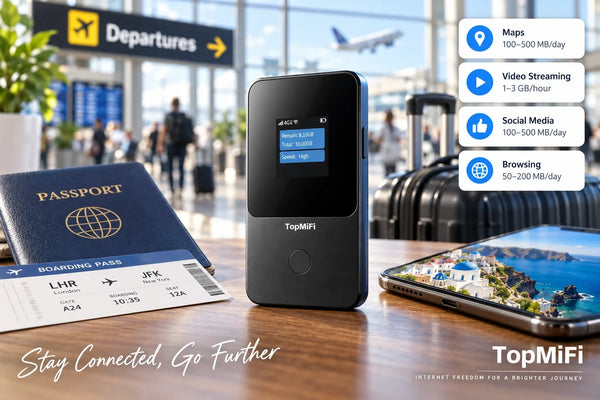
Germany is a light-data destination for most travelers: your heaviest daily use is maps, browsing, messaging, and the occasional photo upload, all modest next to streaming video. These rough estimates help you plan a plan size:
| Activity in Germany | Rough data use | Intensity |
|---|---|---|
| U-Bahn & maps | ~5 MB per hour | Very light |
| Browsing & bookings | ~10–25 MB per hour | Light |
| Messaging & social posts | ~10–30 MB per hour | Light |
| Video calls home | ~0.5–1.5 GB per hour | Heavy |
| Streaming on the train | ~1–3 GB per hour | Heavy |
A typical sightseeing day of maps, browsing, and messaging uses surprisingly little, so a plan that starts with data included and lets you top up as needed is ideal. If you'll stream on long ICE train journeys or video-call home often, plan for the heavier end — and remember a shared hotspot pooling data across a family is far more efficient than everyone buying a separate plan.
What about calls and texts in Germany?
Most travel setups — eSIMs and pocket WiFi alike — are data-only, and in Germany that's rarely a problem. WhatsApp is the default way most people here message and call, and it's how many hosts, guides, and businesses prefer to be reached. With a data connection active, WhatsApp, FaceTime, and other call and messaging apps work exactly as they do at home, with no traditional voice plan and no per-minute charges.
Your home number doesn't disappear either. Because a travel eSIM or a virtual-SIM hotspot adds data alongside your existing SIM rather than replacing it, your regular line stays in your phone — so you can still receive an important text, like a bank verification code, while doing your real communicating over apps. If you specifically need a German number for a particular booking, that's one of the few cases a local SIM helps; for the vast majority of travelers, data plus WhatsApp covers the whole trip.
Setting up WiFi for your Germany trip, step by step
Whichever no-SIM route you choose, getting connected in Germany is simple:
- Count your devices. Just your phone points to an eSIM; a partner, kids, or a laptop points to a portable hotspot.
- Arrange data before you fly. Install a Germany or Europe eSIM plan, or pack a hotspot that arrives with data included, so nothing needs sorting after you land.
- Switch on at the airport. Enable your eSIM line or power up the hotspot as you clear the terminal and give it a minute to find a German network.
- Connect and navigate. Open your maps and the DB Navigator app and you're ready for the train or U-Bahn into the city — no shop stop required.
- Top up if you need more. Add data as you go rather than over-buying up front.
Tips for staying connected across Germany
- Save offline maps of each area. Download your cities plus any rural, forest, or Alpine regions in Google Maps so you can still navigate through a dead spot.
- Keep a hotspot charged for long days. A battery model doubles as a power bank; top it up overnight so it lasts a full day of sightseeing and train hops.
- Expect gaps on rural rail and in the countryside. Germany's Funklöcher mean signal can drop briefly on some train routes and in remote areas — your device reconnects automatically as soon as you're back in coverage.
- Keep maps handy for cash and ATMs. Germany still runs heavily on cash in smaller places, so a live connection to find the nearest ATM saves you hunting around.
- Position a hotspot near a window. In a thick-walled old building or a rural guesthouse, signal is stronger by a window, so place an always-on unit there as your room base.
WiFi in Germany: options at a glance
Here's how the main ways to get online in Germany compare on the questions travelers ask most.
| Option | Needs a physical SIM? | Best for |
|---|---|---|
| Your own no-SIM hotspot | No | Families, groups, multi-country Europe trips |
| Travel eSIM | No | Solo travelers with a compatible phone |
| Rental pocket WiFi | No | A one-off trip, no purchase wanted |
| Local German SIM | Yes | Solo, longer single-country stays |
| Carrier roaming | Uses your home SIM | EU travelers, or a quick overnight |
Which option is right for your Germany trip?
It comes down to who's traveling and how many devices need to be online. A solo visitor with a newer phone and light needs can do everything on a Germany or Europe eSIM — quick to activate, nothing extra to carry. A couple sharing maps and photos, a family where the kids each have a device, or anyone bringing a laptop for work will get more from a portable hotspot that puts everyone on one private connection, without checking whether each phone supports an eSIM.
If Germany is one stop on a wider European tour — or the first of many future trips — owning a no-SIM device that spans 150+ countries makes the most sense, since it replaces a string of rentals, local SIMs, and roaming guesswork with a single reusable tool that works the same across every border. For a quick one-and-done visit where you'd rather not buy anything, an airport rental or a Germany eSIM still does the job. Match the tool to the trip and you'll be online from the U-Bahn platform to the Bavarian Alps without a second thought.
Frequently asked questions
Do I need a SIM card to get WiFi in Germany?
No. You can stay online in Germany with a travel eSIM installed on your phone or a no-SIM pocket WiFi device with a virtual SIM — neither needs a physical card. A local German SIM is one option among several, not a requirement.
Is mobile coverage in Germany reliable?
In cities and along major routes, yes — 4G LTE and 5G are fast and dependable. Germany is known for occasional "dead spots" (Funklöcher) in rural areas and on some train routes, though these are steadily being closed. A no-SIM hotspot connects to whichever local network is strongest where you are, which is the best way to stay online; save offline maps for remote stretches just in case.
Does a "Europe" eSIM or hotspot include Germany?
Almost always, since Germany is in the EU and sits at the centre of the continent — but it's still worth a quick check. A good no-SIM hotspot with 150+ country coverage includes Germany alongside its neighbours, so one device covers a multi-country trip through the region.
Will my EU phone plan work in Germany?
Yes. If you have a mobile plan from another EU country, "Roam Like At Home" lets you use your domestic allowance in Germany at no extra charge. Travelers from outside the EU — the US, UK, Canada, Australia and beyond — pay standard roaming rates, so a travel eSIM or no-SIM hotspot is usually far cheaper.
Will one device keep me online across Germany and neighbouring countries?
Yes, with a no-SIM hotspot. Because it connects automatically across 150+ countries, a single device carries you from Germany into Austria, Switzerland, the Czech Republic, the Netherlands, France and beyond with no new plan and nothing to swap — ideal for a central-European rail trip.
Does pocket WiFi work on German trains and in the countryside?
Mostly, yes — but expect the occasional brief drop. German trains and rural areas still have some coverage gaps, so signal can cut out for a few minutes before returning. Your hotspot reconnects automatically the moment you're back in a covered area, and offline maps cover you in the meantime.
Can one hotspot keep my whole family online in Germany?
Yes. A portable hotspot shares one private network across multiple phones, tablets, and laptops at once, so a family pools a single plan instead of buying separate data for each person — cheaper and simpler than everyone going it alone.
Is there free WiFi on German public transport?
Often, yes — many long-distance DB trains and some city networks and stations offer free WiFi, but it can be slow or patchy once busy, and it won't help you while you're walking between stops. It's a useful bonus rather than something to build your trip around.
Should I rent a pocket WiFi in Germany or bring my own?
Renting suits a single one-off visit; owning a no-SIM device wins if you travel more than once, since it skips daily fees and returns and works across 150+ countries. Over a couple of trips, buying usually costs less and hassles you less.
Which messaging app should I use to stay in touch in Germany?
WhatsApp is the default in Germany and the easiest way to reach hosts, guides, and locals, but FaceTime, Messenger, and other apps all work fine over your data connection too. As long as you have a hotspot or eSIM active, any of them lets you call and message home for free.
The bottom line
Getting WiFi in Germany is easier than ever, and you don't need a SIM card to do it. Between a travel eSIM and a no-SIM pocket WiFi device, you can land and be online in about a minute — ready to navigate the U-Bahn, catch your ICE trains, find an ATM, and share the trip — with no shop queue and no ID-registration hassle. The one thing to keep in mind is Germany's coverage: excellent in cities, occasionally patchy on rural rail and in the countryside, so a device that hops onto the strongest local network, plus offline maps, keeps you covered. Solo travelers can keep it light with an eSIM, while couples, families, and anyone continuing on across Germany's many borders are best served by a portable hotspot that shares one connection everywhere and spans 150+ countries. Sort your data before you fly, and Germany — and the rest of Europe — opens up from the moment you arrive.
Stay connected in Germany with TopMiFi →
Coverage, device compatibility, data allowances, and roaming rules vary by option and destination and can change over time. Confirm current details, including whether a plan covers Germany, before you travel to make sure your chosen setup fits your trip.